
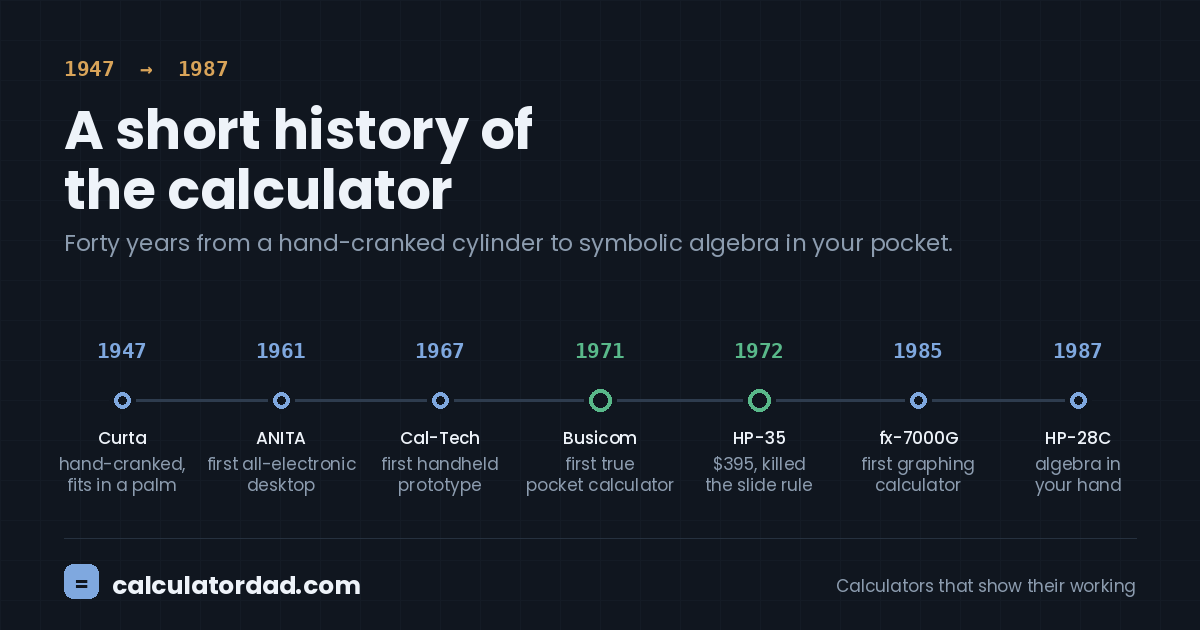
For about 4,000 years, calculating meant beads, pebbles or lines on a board. Then in roughly 350 years we went from the first gear-driven adding machine to a chip that does algebra. Most of the change came in one decade, from 1964 to 1974, and one calculator from that decade gave the world the microprocessor.
Beads, boards and rulers
The oldest calculating tools are counting boards and the abacus. The Salamis Tablet, a marble counting board from about 300 BC found on a Greek island in 1846, is the oldest surviving one. Bead abacuses spread across China, Japan and Russia and are still taught today.
In 1614 John Napier published logarithms, which turn multiplication into addition. Within a decade William Oughtred had put two logarithmic scales side by side and invented the slide rule. Engineers carried one for the next 350 years.
The age of gears (1623–1970)
Building a machine that did arithmetic by itself took far longer than anyone expected. The hard part was the carry: when 999 becomes 1,000, three wheels have to turn at once, and early machines jammed.
- 1623Wilhelm Schickard describes a “calculating clock” in letters to the astronomer Johannes Kepler. The machine being built for Kepler burns in a fire before it is delivered, and the drawings are lost until 1935.
- 1642A teenage Blaise Pascal builds an adding machine to help his father, a tax official, with his sums. He goes through about fifty prototypes and builds around twenty machines, but they sell poorly. Nine survive, most of them in France.
- 1673Gottfried Leibniz shows a wooden model of his stepped reckoner to the Royal Society in London. Its stepped drum, the “Leibniz wheel”, stays in calculator designs for the next 275 years.
- 1851The Arithmometer, patented by Thomas de Colmar in 1820, goes into production in Paris. It is the first calculator sold in real numbers: about 5,500 are built by 1915.
- 1873Willgodt Odhner designs the pinwheel calculator in St Petersburg. Copies such as the Brunsviga and the Soviet Felix are made well into the 1970s.
- 1886William Burroughs founds the company that becomes Burroughs Adding Machine, and the printing adding machine moves into offices and banks.
- 1887Dorr Felt patents the Comptometer. His first model, finished around New Year 1885, was built in a macaroni box with skewers, staples and rubber bands. Each key adds its value the moment you press it, so a trained operator can add columns of figures at speed.
The calculator designed in a concentration camp
The last great mechanical calculator has the darkest origin. Curt Herzstark, an Austrian engineer whose father was Jewish, was working on a pocket calculating machine when he was arrested in 1943 and sent to Buchenwald. The camp's SS officers let him keep working because they wanted to present the finished machine to Hitler.
By the time the camp was liberated in April 1945, Herzstark had redrawn the whole design from memory. It went into production in Liechtenstein in 1947 as the Curta. It looks like a pepper grinder, you turn a crank on the top, and it adds, subtracts, multiplies and divides. About 140,000 were made. Rally drivers used them to work out times and distances well into the electronic era.
Valves and transistors (1961–1967)
Electronic computers existed from the 1940s, but they filled rooms. The first electronic machines built only to calculate were still desk-sized.
- 1961Britain's ANITA, made by Bell Punch, is the first all-electronic desktop calculator. It uses glowing Nixie tubes for its display and weighs about 14 kg. By 1964 it costs £355 and is selling close to 10,000 a year.
- 1964Sharp's CS-10A is one of the first all-transistor desktop calculators. It weighs 25 kg and costs ¥535,000. The Friden EC-130 goes on sale in the US the same year with a small TV-style screen and Reverse Polish Notation, a bracket-free way of entering sums.
- 1965Olivetti's Programma 101 can store a program on a magnetic card. About 44,000 are sold at $3,200 each, and NASA uses some of them while planning Apollo 11.
- 1967At Texas Instruments, Jack Kilby, Jerry Merryman and James Van Tassel build Cal-Tech, a prototype small enough to hold. It runs on a rechargeable battery and prints its answers on a thin paper roll. The patent is granted in 1974.
One chip changes everything (1969–1972)
In 1969 a Japanese calculator company, Busicom, asked a young American firm called Intel to make a set of twelve custom chips for a new printing calculator. Intel's engineers suggested four chips instead, one of which could be programmed to do general work. That chip was the Intel 4004, announced in November 1971. It was the first commercial microprocessor, the ancestor of the processor in every computer and phone since, and it exists because someone wanted a better desk calculator.
Meanwhile Mostek made the first “calculator on a chip”, the MK6010, also for Busicom. It went into the Busicom LE-120A “HANDY” of early 1971, the first calculator that truly fitted in a pocket. It had a red LED display and cost $395.
The HP-35 and the shirt pocket
Bill Hewlett, co-founder of Hewlett-Packard, was convinced engineers would buy a scientific calculator if it fitted in a shirt pocket. HP's engineers built one. The HP-35 went on sale on 4 January 1972, named after its 35 keys, at $395, roughly $3,000 in today's money. It did logarithms and trigonometry, the jobs engineers had used slide rules for. It sold more than 100,000 in its first year.
The calculator wars (1972–1980)
Once a calculator was one chip, the price collapsed. Casio's Mini of 1972 sold a million units in ten months. Sharp's EL-805 of 1973 was the first with a liquid-crystal display, which used a fraction of the power of the glowing LED screens and made battery life a matter of months rather than hours. The Texas Instruments TI-30 scientific calculator launched in 1976 at $24.95 and sold about 15 million by 1983. Around 1978 the first solar-powered models appeared.
In six years the price of a scientific calculator fell from $395 to under $25. Slide-rule makers stopped production one by one; Keuffel & Esser made its last on 11 July 1976 and gave it to the Smithsonian.
Graphing, algebra and exams (1981–today)
- 1981The HP-12C financial calculator launches. It is still made today and is one of Hewlett-Packard's best-selling products of all time.
- 1985The Casio fx-7000G is the first calculator that can draw graphs.
- 1987The HP-28C is the first handheld that does algebra with symbols, not just numbers.
- 1990Texas Instruments enters the graphing market with the TI-81. TI says it has since sold more than 90 million graphing calculators.
- 2004The TI-84 Plus arrives. It still costs around $100, and it is still on school supply lists across the US.
Exams are the main reason dedicated calculators survive. Phones are banned from exam halls, so exam boards write rules about which calculators are allowed. The digital SAT now has a graphing calculator built into the test software. The ACT bans calculators that can do algebra with symbols, such as the TI-89. The CFA exam for finance professionals allows only two models. Which calculator is allowed where is covered in our guide to the types of calculator.
The disappearing calculator
In 1986 calculators were still the main way the world did its computing. A 2011 study in Science by Martin Hilbert and Priscilla López estimated that they accounted for 41% of the world's general-purpose computing capacity that year. By 2000, personal computers had 86%.
Calculators did not get worse. Everything else got a processor, often one descended from that Busicom chip, and arithmetic moved into devices people already carried. What was lost is that a physical calculator cannot go out of date. An online calculator can be quietly wrong for a year, which is why every figure on this site is dated and sourced.
Quick answers
Who invented the calculator?
No single person. Wilhelm Schickard designed the first known mechanical calculator in 1623 and Blaise Pascal built working adding machines from 1642. The first all-electronic desktop calculator was Britain's ANITA in 1961, and the first handheld electronic prototype was built at Texas Instruments in 1967.
What was the first pocket calculator?
The Busicom LE-120A “HANDY”, released in Japan in early 1971. It used a single Mostek chip and a red LED display, and cost $395.
What was the first scientific calculator?
The Hewlett-Packard HP-35, launched on 4 January 1972 at $395. It was the first handheld calculator that could do logarithms and trigonometry.
When did calculators become cheap?
Between 1972 and 1976. The HP-35 cost $395 in 1972; the TI-30 scientific calculator cost $24.95 in 1976. Single-chip designs and LCD screens drove the price down.
How is the calculator connected to the microprocessor?
The Intel 4004, the first commercial microprocessor, was designed for a Busicom printing calculator. It was announced in November 1971.
Sources
- Wikipedia, “Calculator”; Wikipedia, “Mechanical calculator”
- Computer History Museum, “Revolution: Calculators” (Schickard, Leibniz, Curta)
- Wikipedia, “Pascaline”; Wikipedia, “Arithmometer”; Wikipedia, “Comptometer”
- Wikipedia, “Curt Herzstark”; Wikipedia, “Curta”
- Vintage Calculators Web Museum, ANITA Mk VIII; Sharp Compet CS-10A
- Smithsonian National Museum of American History, Texas Instruments Cal-Tech prototype
- Intel, “The Story of the Intel 4004”
- Vintage Calculators Web Museum, Busicom LE-120A “HANDY”
- Hewlett-Packard, HP-35 history; Computer History Museum, “This Day in History: 4 January”
- Sharp, EL-805, the first LCD calculator; Casio corporate chronology
- Casio, the development of the fx-7000G; HP history, “A best seller” (HP-12C)
- Robert A. James, “The Deaths of the Slide Rule”, Journal of the Oughtred Society 23:2 (2014)
- ProMarket, Stigler Center, University of Chicago, on Texas Instruments and the TI-84 Plus
- College Board, SAT calculator policy; ACT calculator policy
- Martin Hilbert and Priscilla López, “The World’s Technological Capacity to Store, Communicate, and Compute Information”, Science 332 (2011): 60–65. doi:10.1126/science.1200970